Saturday, February 27, 2021

Super FamiComplete #85: Pit-Fighter


Title: Pit-Fighter (NA)
Release Date: March 1992
Developer: Tengen
Publisher: Tengen

I will be honest about this up front, but this is just a really awful game. Arguably one of the most bare bones and poorly constructed games I have played for this blog thus far. Luckily, this game is also one of the shortest games that we have played yet.  My playthrough of the single player game took a grand total of 11 minutes. 

Background

This game was originally an Atari arcade title, and was most known for using its digitized actors. The original arcade game, while also not being very good, showed a lot more promise than what was ported to the SNES. The game let you choose from three fighters, Buzz, Ty, and Kato, and you went through a series of underground pit fights against a variety of opponents in hopes of taking on the champion, the "Masked Warrior." You had to make it through seven matches, and your life would carry over between matches; the score system of the game would be how much money you earned from the people betting on you in the fight. The crowd, in the arcade title, would even interact with the fight, throwing in power ups and weapons to make the fight more interesting. Sometimes, members of the crowd would even reach out and stab your fighter, which is mildly terrifying in thought. 

Before we talk about the port, it must be mentioned that this idea of underground and illegal "pit fighting" seemed to be a big thing with movies in the 80s and 90s, especially with the popularization of martial arts movies and actors becoming more mainstream. Jean-Claude Van Damme comes to mind specifically, as he had a series of movies about underground fight clubs, such as Lionheart, The Quest, Bloodsport, and Kickboxer. This game really seems to take inspiration from Lionheart in particular. While there are some media that still focus on this "setting" (Netflix's Kengan Ashura and Baki are some recent examples) this seems to be a genre that is on the decline. 

Now the SNES port is a really rough one. The game has no intro cutscene or context, you press start, choose one of the fighters, and you are thrown into your first match. Instead of eight opponents, you fight five, and they have cut out all the power-ups or weapons from the game. The game still supports two player versus which is kind of neat as you don't play against each other, but instead fight two versions of each opponent together. Overall, though, this is an incredibly hewed game. 

Gameplay
This game is one of the most rudimentary and sloppy "fighting" games that I have played. You have a punch button, a kick button, and if you press both together you do a "special move." What hinders this is the animation of your digitized actors is incredibly poor and limited, as your characters just jolt from key frame to key frame. The result is that each fighter just looks like they are seizing and flailing with no sense of visual coherence. Punches don't look like punches, kicks don't look like kicks, and nothing has a sense of impact. Without your health going down, there is no real indication of who is doing damage to who. Your sprites, too, are weirdly too small; one thing Mortal Kombat did really well was to digitize the actors so they were tall and each part of their body was clearly animated. In Pit-Fighter, all of the characters are boxy and squat, which aids in the visual confusion. Honestly, you should watch a youtube video just to see how piss-poor this looks.

This poor digitization extends to the truly god awful crowd. They are arranged with no real sense of visual mis-en-scene or proper visual organization. The crowd looks like someone's amateur attempt at photoshopping different people into a photograph. They all animate strangely, and are all oddly the same shade of olive green. 

The design of your opponents is no great shakes either. Your first opponent, the Executioner (truncated to just the Exec), is just a fat guy in a ski-mask. Your second opponent is a squat guy with shades and a bandana, and even your champion is a squat guy in a mask. Not good at all. 

Finally the game is a crap shoot in its difficulty. I beat the first three matches as Buzz, the pro-wrestler, by just holding forward and spamming the punch button. The enemy fighter could never get up off the ground without me awkwardly punching him back to the pavement. The later fights are certainly more "challenging" but it just felt like luck if I was able to knock down the fighter first and could stun lock them. As well, Buzz seems like the only viable choice of a fighter, as Ty is a kickboxer who kicks too slowly, and Kato, being a 3rd degree blackbelt, bows at the beginning of each match, which the enemy fighter hilariously ignores and starts wailing on you. All told, you can, with some luck, clear the game in less than ten minutes, whereupon your champ is hoisted up on a forklift as the underground fighting master. 


Music
It's really bad, but here it is anyway. Like the game, the amount of music is quite limited.


Ads
They are really milking this one picture. 


Final Verdict
Watch a youtube video if you want a good laugh, but otherwise, just ignore this one. It is true kusoge garbage. 


Thursday, February 4, 2021

Super FamiComplete #84: The Addams Family


Title: The Addams Family (NA/JP)
Release Date: March 1992
Developer/Publisher: Ocean

So before we finish up the last game for March 1992, we are going to do the four USA developed releases, which due to the staggered and unplanned releases in the United States' retailors, don't have specific release dates, but just the release month. And, per usual, the US developed games aren't that good. We are, arguably, going to play the best of the four with this entrant. 

Background
The Addam's Family is an exploration heavy platformer developed by Ocean. The Addam's Family is a licensed game based off of the 1991 popular film...


...which in turn is based off the sitcom from the 1960s...


...which in turn is based off Charles Addam's New Yorker cartoon...


The titular Addams are a horror themed "American" family, and an odd collection of weirdos. You have Gomez, the lothario retired lawyer who shas a lust for life and is passionately in love with his wife, Morticia. Morticia is a tall, pale, and detached from emotions in an aristocratic sense, but has a deep love for her family (she keeps carnivorous man-eating plants as a hobby). They have two children, Wednesday and Pugsley; Wednesday is a quiet borderline sociopathic little girl with a macabre sense of humor, and Pugsley, who is arguably the most normal though he is an extra destructive in his boyhood exuberance. Rounding out the family is Lurch, the tall Frankenstein-esque butler, Uncle Fester, the strange Igor-esque brother to Gomez who is a torture enthusiast and general masochist, Grandma, an old witch/mother of Morticia, and finally Thing, who is a disembodied hand.

The movie that this game is based on was relatively popular and garnered one direct sequel. It starred the late-great Raul Julia as Gomez, Angelica Huston as Morticia, Christina Ricci as Wednesday, and Christopher Lloyd as Fester. It centers on a group of con-artists trying to convince Gomez that one of their compatriots is actually Uncle Fester, who was lost at sea for years; ironically, this stooge actually happens to be Fester. They search the estate looking for the treasure, and eventually resort to holding the family hostage until the family fortune is handed over. There is a lot of comedy, some fencing action, some good gags, and an MC Hammer title song. Overall, a decent and enjoyable comedy from the 90s that retains a lot of its charm. 

The game is tangentially related to the film. You play as Gomez, and your family has gone missing! You need to navigate your way around the house and surrounding estate in order to defeat the monsters and villains (one of which kind of looks like one of the conmen?) who have taken your family hostage. 

The game itself was developed by Ocean, a European game developer known for licensed games and Arcade ports, though they did develop the really weird platformer Mr Nutz!

Gameplay
The game begins with Gomez in front of the manor, and you are free to explore any part of the manor in any order (with very few exceptions). There are is the manor itself, which has several wings like the Greenhouse and the Kitchens, and then the surrounding grounds. Each of these areas leads to specific stages or dungeons, which can be quite long. Darted throughout the maps are upgrades of various kinds, some permanent some temporary, and bosses for you to find and fight. This game is very much a rudimentary metroidvania in its style. 

The first thing you are going to want to do is hunt down specific bosses, such as the bird at the old tree or the snowman in the freezer, as these bosses will reward you will permanent life upgrades. Old Gomez starts with just two hits available, and it is easy to lose them quickly! In fact, even with health upgrades this game is pretty difficult. There are some reasons for this: Gomez always sits in the middle of the screen and moves fairly quickly, which means that you don't have much warning before and enemy is in your path; it is very easy to make quick mistakes in this game. Also, Gomez doesn't have much of a defensive vocabulary; unless you pick up a weapon, Gomez can only jump on his enemies (and some are immune to that). Luckily there are rapiers and flying hats which shoot fireballs which make this a little easier. As well, Gomez has a very high jump that is very fast, and his controls are very sensitive to input when Gomez is in the air; Gomez has no realistic momentum, but instead all player input. 


The difficulty is exacerbated by some pretty punishing level design. The game and many of its dungeons are very maze like, and there is no clear indication of where to go to find the next family member. This means that you are going to be wandering around and beating your head against walls and levels trying to figure out where to go. Some branches within dungeons will lead nowhere, and some seemingly important areas will actually be dead ends. As well, some of the platforming sections are really tortuous and do not play well with Gomez's movement. For a guy with some serious ups, many dungeons are tight and cramped, leading to many parts where Gomez bumps his head on a low ceiling and plummets into a lava pit. There is two really hair-pulling sections in the lava dungeon level where you have to do a series of coyote-time jumps (meaning jumping right as you are going off a ledge) in order to make it up to the next level. There is a bunch of sections where you have to jump off enemies in order to reach next ledges or clear gaps. Even worse, the game really doesn't have great checkpointing, with long rooms that seemingly go on for minutes and minutes. If you die, you go back to the beginning of that portion of the house. 

The bosses, luckily, are pretty simple. They will mostly just move or hop around, maybe throw some projectiles, and generally are the easier parts of the game. Even the final boss, "The Judge," is just a reskin of the earlier goblin boss. If you beat him, Morticia and the family is saved, and everyone lives happily ever after. 

Luckily the game is generous with lives. The "Continue?" screen actually has a secret room that continually fills with lives, so you aren't really in danger of a game over if you know that is there. As well, there is a password selection so you can pick up where you left off in the game. 


Music
The music is a nice homage to the Addams in general. It captures the feel of the "eerie" harpsichord sound. 

Art and Ads

Just a single magazine ad (for the Sega game) sadly!


Final Verdict
For an Ocean game and a licensed, "US" developed (okay European) property, this game isn't terrible. I would have had a ton more patience for this game as a kid, though nowadays it is pretty vexing. Worth playing? Yes! Worth spending money on for a collection? Sure! It is a moderate level collectible on Amazon (about $20-25 dollars), so you aren't breaking the bank. I would wait for the price to drop five bucks before buying. 


Friday, January 1, 2021

Super FamiComplete #83: Top Gear


Title: Top Gear (NA) Top Racer (JP)

Release Date: 03/27/1992

Developer: Gremlin Graphics

Publisher: Kemco

Happy New Year everyone. I am pretty proud of the fact that we made it through the redux section of the blog and am now onto the new entrants in Super FamiComplete. Capcom A to Z will be updated soon too (Apollo Justice is taking some time to work through, but I am compelled to finish it), as well as some new projects I'm thinking of starting. All said, 2021 should be an exciting year. 

To start us off on our road to 100 games, though, is another racing game, this time by Gremlin Graphics and Kemco. 

Background

Though released in Japan first by Kemco, this game is actually developed by a British development house called Gremlin Graphics (later Gremlin Interactive). This was a company that arose in the British Home Computer market of the 1980s, during the era when the "bedroom coders" would develop games for British PCS. After that market/development method gave way to actual game development houses, Gremlin Graphics pivoted to the console market. Gremlin is best known for its Actua sports series and other racing games, such as the Lotus racing series. This developer was eventually absorbed by a French company, Infogrames, before that tanked in 2003. Nowadays, most of the developers from Gremlin moved onto working for Sumo Digital, the developers of the recent Sackboy: A Big Adventure for the PS5. 

Gameplay

The game is a racing game in the same vein as Outrun where the camera is placed right behind your vehicle and you follow it along a swerving track. Unlike F-Zero where you are really rotating the screen, in this you are directly controlling the car. Its likeness to Outrun is a good thing, though, as this is one of the more playable racing games that has been featured on this blog in quite some time. 

You first start by picking your loadout for the races: you choose your control scheme (one of which is to hold the controller upside down (?!?)), whether you will drive manual or automatic, and which model of car you will use. You then enter the racing circuit, which features four races for each continent. For example, the first tournament takes place across North America, with races in Las Vegas, Los Angeles, New York, and San Francisco. Races can vary from three laps up to six laps. 

Racing is pretty simple: you can accelerate, brake, and use up to three nitro boosts per race, which end up being pretty essential to winning. You can't really crash, but there are some hazards that slow you down, such as hitting road work signs and other cars. One thing you have to monitor is your gas! If you ride the nitro too much, or hit too many other hazards, you might run out of gas. You can stop in your pit for extra, which might be necessary in the longer races, but this eats up precious time. 


One interesting quirk in this game is the push for two-players. In the early days of the SNES, two player racing games were rare, which makes this a rather novel game. Even if you aren't playing with another character, though, there will always be a split screen with another computer racer playing the 2-player. This sets up a neat little rivalry mechanic for throughout the tournaments. 

The game, overall, is not that difficult, but a breezy yet fun experience. I managed to beat it in an afternoon. The graphics, music, and locales are all varied enough to keep the game interesting from tournament to tournament. The game also approximates high speeds pretty well for an SNES game, making it one of the more thrilling racing games from this era. There were several "close calls" versus the computer racer that made the races pretty exciting. 


Music

As previously mentioned, the music in this game is pretty top notch! Check it out. 


Ads and Commercials


Final Verdict
This is a really solid racing game! I highly recommend at least checking it out. It was really well received at the time, and also popular enough to have two sequels that will eventually be covered in this blog. Next up we have the last Japanese only release for March, and then the US developed games for March. 


Sunday, December 20, 2020

Super FamiComplete #82: The Great Battle II: Last Fighter Twin (Redux)


Title: The Great Battle II: Last Fighter Twin

Release Date: 03/27/1992

Developer & Publisher: Banpresto

So here we have our first Japanese only sequel to a Japanese only game. Wow, how far we have come in only eighty-three games. This will be a short post because there really isn't too much meat on these bones. 

Background
This game was developed by Banpresto, the development company that made some, culturally, very "Japanese" games. Nowadays, they make figurines and sculptures of manga and anime figures. 

 If you remember from the first Great Battle, this is a super deformed take on several Japanese tokusatsu and anime franchises, and fits into its own little franchise known as the Compati Heroes series.  This game includes the famous F-91 from the Gundam series, Kamen Rider, Ultraman, and an original character who ended up serving as Banpresto's mascot for the 90's, Fighter Roar (his mask is supposed to represent the mask in the Banpresto logo). 


The story is a weird one to be sure: after the first game where peace had come to the world of SD Nation (remember SD means super deformed), the peace is disrupted when the weather starts to become incredibly erratic, and monsters start to appear. The heroes decide to look for the four magical Gachapon capsules (you know those little capsules you get from gumball machines with a prize inside) that can grant any wish when they are all collected. At the same time, though, the villain of this series, Dark Brain, is also on the hunt for the capsules too to enact his evil plans. Dun dun duuuuuuuuun. 

Gameplay
Unlike the previous entry in the series, which was a top-down action platformer, similar to Link to the Past or Lagoon, this one is a side scrolling beat-em-up. It...is not very good to be honest. A good beat-em-up needs frenetic and fast action with set pieces, enemy variety, a varied move system. This game has none of those things. The game is barely animated, with many of your attacks using two or three frames of animation. This gives your attacks very little impact, flow, or dynamism; nothing really feels weighty or connects, so the "beat" part of the beat-em-up doesn't feel very good. 


The stages overstay their welcome; each one is very long, and all every stage seems to do is just throw enemies at you. The enemies, who are all based on monsters and robots from each of the respective series, have actually very little variety. There are some stage hazards, such as sand whirlpools or ledges to fall off, but other than that you are just fighting. Finally, the moves of your character are also very basic. You have your regular punches, kicks, throws, and you can pick up weapons dropped by your enemies; instead of special moves using life, you have separate energy bars to use SOME special moves (usually a ranged attack). All in all, this game is very slow paced and boring.

There are some neat things, such as branching paths through the game. This is usually determined by the boss fights. If you can't beat the boss at the end of the stage within a certain time limit, some story contrivance will occur which will set you to one stage instead of another. This is pretty cool, but pretty much the only neat thing this game pulls off. I will also give it credit that many of the SD designs do actually look pretty darn good (plus one of the bosses is a Mummy named Chubby De David; that's amazing). 


Music?
It's not bad. Not great, but not bad.

Final Verdict
While the first game was really fun, you can just tell that they rushed the sequel. It is an incredibly bare bones experience, which is a shame considering all the franchises they had at their disposal. There are THREE more main Great Battle games for the Super Famicom, so hopefully the next game will be a more enjoyable experience. 

Super FamiComplete #81: Super Valis IV (Redux)


Title: Super Valis IV (NA) Super Valis: Akaki Tsuki no Otome  (trans. Virgin of the Red Moon)

Release Date: 03/27/1992

Developer: Laser Soft

Publisher: Laser Soft (JP) Atlus (NA)

This is a series that I have always heard rumblings about, but had no idea really what it was. I knew it involved a female anime style protagonist, and that is really it. I usually got this confused with Aleste for Sega. Anywho, what I am saying is that this is a completely new experience for me. Let's dig in.


Background
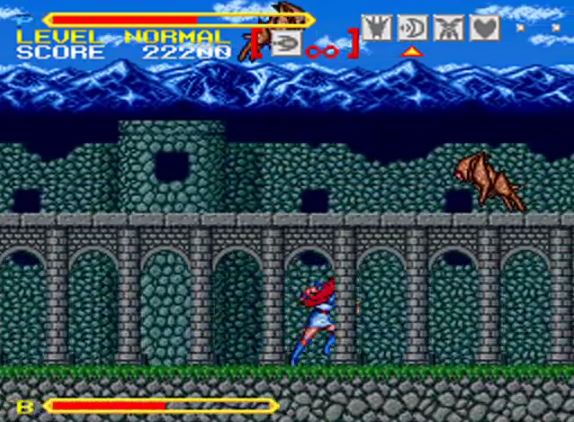
This game ended up being the last true entrant in the Valis series, a series that, surprisingly, is not based on any existing anime/manga, but was formed off a popular manga genre: the magical girl hero genre. The series takes place on the planet of Vecantis, and the main character is a late 80s schoolgirl who is whisked from Japan, given the mystical sword Valis, and is tasked with stopping dark forces from taking over the world. Generally, the series was stretched over the PC-Engine consoles (starting on the PC-88) and the Sega Master system, with this entrant being a retelling of the PC-Engine Valis IV.

This game was developed by Telenet Japan, a games developer who were quite prolific in games that released only in Japan. This game was specifically developed by the team that would end up becoming Wolf Team, the group who would join Namco Bandai and develop the ever popular Tales series of games. Eventually, Telenet folded, and sold off the Valis series to a low-tier developer named Eants, who made the final entrant in the series, Valis X. Valis X had the ignominy of being a new direction for the series as...a hentai game that focused on heavy tentacle and lesbian sex. Yeah...well when Telenet folded in 2007, the rights to the series were scooped up by Sunsoft, but who knows if anything will come of that.

The story of this game is relatively similar to the previous entries. The girl from the first game has disappeared, and it is up to a new red haired girl, Lena, to defeat the demon/dark emperor Gallagher with the mystical sword Valis before he can take over the planet of Vecantis. Before she can challenge the King Gallagher, she must defeat his three generals first.

Apparently in the PC-Engine version, there are fully animated cutscenes (one of the staples and claims to fame of this series overall), as well as two other playable characters, but in this revision or port, most of those cutscenes have been scrapped, and we are kept to the one playable character.


Gameplay
The game is an action platformer, akin to a mix of Ys III and Castlevania. The main goal is to navigate to the end of each stage, which can span multiple rooms, and defeat the boss at the end. Lena is equipped with the eponymous Valis sword, and has a short ranged attack and, by pressing up and attack, shoot a horizontal fireball from the sword. Along the path, the player can pick up some items, which either provide an invulnerability armor, health, or a different energy blast to shoot from Valis (i.e. a homing missile, a sweeper, or one geared to take out aerial creatures). The game also features some slight RPG mechanics; for every 10000 "points" from killing enemies, your health bar will increase a small amount.


The levels themselves are very pretty and aesthetically pleasing, especially when they utilize some effective parallax scrolling. As far as design and layout, though, the levels can be rather bland. Generally, they are travel to the right, perhaps across an upper or lower level, with a series of enemies dotted along the path. Some levels are more vertically inclined, with you having to travel up and across the level, but honestly the design is very amateurish. Most of the "platforming" challenges have you jumping across gaps, but the penalty for failing these jumps is a set back in progress, as you will usually just fall to a previous section of the map. Like Mario, Lena has two speeds of movement, and many of the platforming challenges rely on her building up momentum before she can complete the jump.

The game is quite challenging. There are no "lives" systems, and you are able to take a great deal of hits before dying, but if you do die, then you must restart at the beginning of the entire stage. This includes the boss fights, many of which can be quite challenging. If you die, your "level" resets back to zero and you lose all of your power-ups. It doesn't help that your sprite is very large, but the game balances this by giving you a decently ranged attack and a high jump. Power-ups become a necessary affair to seek out and stock.

Speaking of bosses, many of them are simple "memorize the pattern" affairs, but some play with this formula. One boss, the crystal core, asks you to attack a moving core with your distance attacks while a creature attacks you and blocks it; another boss "phase shifts" between three different forms (a statue, a harpy, and a mermaid) and it serves as more of an endurance trial. The general bosses are meant to be the big "set piece" bosses, and some of them can be quite cheap. The first general, a man riding a tiger, takes a ton of damage and can be quite hard to avoid. The second generals fight, in particular, must have triggered a ton of seizures, and was setting off my motion sickness with the fight (a spinning room coupled with blinking "phantom clones" that he sends at you).


After the crystal caverns (level 5), the game cranks up the levels of shenanigans and difficulty to the nth degree. The sixth level is a true maze where enemies attack you from all angles, and the boss is quite tedious. The final level cranks this up even more, with a boss rush of all three generals, and then a final boss fight that takes around ten minutes (a very long time in an action platformer) to defeat.

How is the music?
The music is surprisingly really good!


Ads, Art, Commercials

Final Verdict
I will admit, the first several levels are very fun. I enjoyed the aesthetic, I really enjoyed the music, and the gameplay was serviceable. After level five, though, the game becomes too difficult to find enjoyable. I would recommend playing this with save scumming if you want to actually beat it, unless you want to memorize a lot of patterns and enemy locations. 

#127: Pachinko Wars

  Title: Pachinko Wars Release Date: 7/17/1992 Developer: OeRSTED Publisher: Coconuts Japan It is finally time for the ever popular gambling...