Saturday, February 22, 2020

Super FamiComplete #7: Pilotwings (Redux)


Title: Pilotwings

Release Date: December 21, 1990 (JP), August 23, 1991 (US)

Developer: Nintendo EAD

Publisher: Nintendo

I love Pilotwings. It is another game I return to with some regularity. I love the music, the characters, and the gameplay. This is another one of my favorites from when I started this blog. 

Background
One month after the launch of the Super Famicom and we have the third Nintendo developed game. When I first mentioned F-Zero and Super Mario World, I mentioned how there were three games in development by Nintendo EAD for the launch of the Super Famicom, and this is the third and final one. 

This was another game developed by Nintendo EAD. While Shigeru Miyamoto oversaw development and produced the game, the director in this case was Tadashi Sugiyama. He is a veteran developer at Nintendo, but seems to often work on the projects that require a lot of technical innovation or radically new gameplay styles. For example, he works on games like Luigi's Mansion, directed the very first Super Mario Kart, directed Zelda II, and even the much maligned Star Fox Zero. In this case, Pilotwings was to be showcased as another tech demo for the Mode 7 features of the Super Famicom. Each of the "simulator" portions of the game shows of the faux-3D capabilities of Mode 7, and it effectively creates the illusion of depth of field, altitude, and flight over a surface (albeit a completely flat planar surface). 

The game's first incarnation was as a tech demo known as Dragonfly which was shown at a trade show in 1988. This demo showed the capabilities of Mode 7 by having a dragonfly fly in a similar fashion to what would become the game-play of Pilotwings. 


Gameplay
Pilotwings is a simplified flight simulator where the player attends a series of flight schools, known as "Flight Clubs" in the game, in order to reach higher levels of certification. At each school, there are four challenges to play through: a light plane challenge, a rocket pack challenge, a hang glider challenge, and a sky diving challenge. 

At each flight school, you have to perform well enough on the challenges to earn enough points overall to earn your certification for that round. With each challenge, you get graded on criteria that determines your point total; for example on the Light Plane challenges, you get graded on the angle of your landing vs. the runway, the speed with which you complete the challenge, if you hit all the rings/targets you were supposed to, and the accuracy overall of your landing in the target zone. 


Each school, as well, has a different coach or trainer. One thing I like is that each trainer has a nice bit of personality. Here is the first trainer, Tony...


Here is Tony mad...
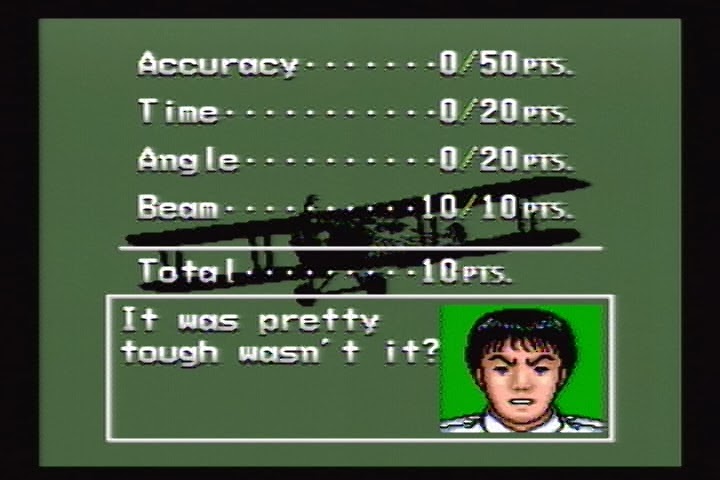

Here is Tony elated...

Here is the next Trainer, Shirley...

Here is Shirley mad (not much difference here)...

Here is Shirley elated (she gets the anime eyes)...

Here is the third trainer, Lance (this guy is my favorite; he looks like he just hates his life)...

Here is Lance mad (he is kind of a sarcastic asshole, but then again, he does live on an island in the middle of the ocean)...

Here is Lance elated...

Finally here is the last trainer Big Al (I had high hopes for him but he is just matter of fact about everything).

 He really has no difference between his normal and mad face, but his happy face is my favorite.
Those are man tears

It adds a nice bit of personality to a game which is pretty much just a series of mini-games. 

After you pass each of the trainer's Flight Clubs, you get selected to participate in a "Secret Mission." Basically the EVIL Organization (that is the actual name, not me emphasizing the word) has kidnapped each of your trainers and are holding them on their secret island base. You have to fly a helicopter, destroy all the surrounding SAM sites with your rockets, land on the enemy base, and then return with your prisoners to the aircraft carrier you took off from. There are two of these missions in the game, and they are very hard to complete, as not only are the SAM site missiles hard to dodge (one hit and you are dead), but also later in the level the SAM sites are hidden in the forests as well.  These missions are very challenging to say the least. 
After you beat the first helicopter mission, you go back to each trainer for a second round of "Expert" flight school (the main screen also changes as well).


Each trainer will give you much tougher challenges, also with unique weather conditions: Tony now has snow on the ground which obscures your vision, Shirley's runways are now rain-slicked and slippery, Lance has strong winds which push your vehicles all over the place, and Big Al runs his lessons at night now, forcing the player to use their radar. The second half of the game is pretty tough.

 
There are also bonus stages available as well, which allow you to rack up extra points after lessons. You can reach these by landing on any of the moving "bonus" pads in your challenges. Granted most of the time if you try for these, you will just land in the water, so the risk really isn't worth failing the challenge. These bonus games are pretty fun, though, and include skydiving as a Penguin in to a pool, or getting to use a Birdman suit. 


What about them tasty Super Famicom Licks? 

The music in this game is really catchy. I find myself getting these songs stuck in my head. I also put them on all the time when I host Smash Bros. tourneys. 


Ads, Commercials, and Art

I could find no ad for Pilotwings in print, but I did find this commercial which featured the game. This was the commercial for the SNES holiday launch season in 1991. Yes that is Paul Rudd.


Final Verdict
In the end, is it a game worth purchasing? I would say yes. It's a pretty fun game overall. The learning curve is a BIT tricky, as unless you read all the menus, you often won't know what exactly to do in each challenge. It is not a game to just play blind; you really should do your homework first and test out the controls. The end reward is very satisfying though, as the game is certainly challenging, but that feeling of completing the game all the way through and earning that Gold Certification is definitely reward enough.

The controls are pretty great for a 16 bit flight simulator, and you never feel as if failing a challenge is the fault of the game. Some mini-games are definitely more vexing than others, especially the Hang Gliding challenge, which has the toughest to learn controls out of any of the vehicles.

The sound work is very good as well, and it really helps pull you into the game. The sound of the wind rushing past you as you sky dive, the screech of the plane scraping against the ground if your plane lands incorrectly, the sound of a hang glider catching wind; all of these are really accurately captured and represented in a 16 bit game. Nintendo really did a great job with the immersion factor on this one. 

The graphics, though, are one of the best features of this game. This game, in the end, is like F-Zero in that it is another game meant to show off the design capabilities of the Super Famicom/SNES and its Mode 7 development mode. This entire game, from the opening animation of the Pilotwings logo dashing towards the screen, to every flight game, is all made in Mode 7 (for those who haven't read the first post on F-Zero, Mode 7 is creating a sense of 3-D graphics by allowing the sprite to move independently from the background). At the time, the graphics in this game were revolutionary; I remember playing this game when I first got the Super Nintendo, and I can remember having played nothing like this before then. It captured a feeling of wonder and that feeling of needing to explore the game's world, and in such a modest game too. It is a beautiful game in motion, and it is just a joy to watch.

 If nothing else, this is another very important game of much historic value for the SNES. Nintendo went on to remember this important title when it released the N64, as they released a sequel, Pilotwings 64, as a launch title for the system. 

Sunday, February 16, 2020

Super FamiComplete #6: Final Fight (Redux)

 
Title: Final Fight

Release Date: 12/21/90 (JP) 8/13/91 (US)

Developer: Capcom

Publisher: Capcom

When I first started this blog, every game seemed to be better than the last (minus Populous); and this game was certainly the peak of that experience. Actraiser was fun, but the world building sections could get a bit dull, and Super Mario World is a classic, but I had played that game a ton. This game, though, while it does have a few faults as far as beat-em-ups go, and was certainly not a stellar port of the arcade version, was just pure unadulterated fun. Now I will mention up front that the SNES version is a port from an original arcade game, and I do have the arcade version on the PS4 Capcom Beat-em-up Collection so this retrospective is going to look at both the original version and this port to point out the differences between the two.

Background
A little about the history of this game. It was originally billed by Capcom as a Street Fighter game, entitled Street Fighter 89', but was going to be a beat-em-up in the vein of Double Dragon II. When it came closer to release, Capcom decided to change the name as they felt that the final game had no relevance to the Street Fighter franchise. The game does hint at this connection to Street Fighter in a tongue in cheek way, as they refer to the one playable character, Mike Haggar, as a former "Street Fighter." Cute. Characters from this series would also appear in the Street Fight Alpha series, such as Cody, Andore, Soddom, Rolento Poison, and Abigail.


The original arcade game was pretty darn successful, and by and large it is a very solid beat-em-up. The basic story is simple but fun; the game takes place in Metro City, a city that has is inundated with crime by the Mad Gear gang. The Mad Gears have maintained a stranglehold on the city through coercion, bribery, and intimidation. The game starts with the newly elected mayor, the burly Mike Haggar, promising to rid the city of the crime of the Mad Gears. The Mad Gears respond by kidnapping Haggar's daughter, Jessica, and threatening to kill her if he doesn't cooperate.


Well, the massive Haggar, Jessica's boyfriend Cody, and Cody's friend Guy aren't going to stand for that, so they set off after the kidnappers, and pretty much just beat the ever-loving shit out of whoever gets in their way. You see, Haggar used to be a professional wrestler and underground pit fighter, Cody is a trained martial artist, and Guy is a legit ninja.

 I guess they just work out together alot...

It's a simple story, but one that is handled in a pretty fun way. The game certainly nods to 80's action movies and some of the excesses of 80's popular culture, (though this game says it takes place "sometime in the 90's"). It definitely has shades of films like The Warriors.

Arcade vs SNES
The original arcade version and the SNES port, while they have similar game feel, have major differences. Many of these changes are because of the initial technological limitations of the Super Nintendo system. To fit such a complex and fluid brawler on a cart, some serious compromises had to be made. The SNES version cut out one of the six stages, completely cut out the character Guy as a playable fighter, and, probably the most controversial choice, cut out 2-player mode completely. Yup, Final Fight for the SNES is a one-player beat-em-up.


 Now normally I find playing beat-em-ups by yourself to be rather boring, but I actually found this one to be pretty darn fun. Capcom made some choices with this port that actually really work for a single-player beat-em-up, as the game-play moves from random and chaotic to a bit more strategic.

Due to the limitations of the system, the SNES version can only handle about three enemy characters on the screen at once (the arcade version has up to seven or eight at a time, sometimes), and Capcom had to realign the enemy placement and "party" structure of the enemies that you face. This allows you, though, to really look at the enemies you face, and plan your attacks accordingly, as you aren't being bum-rushed by a horde of random enemies all at once. Granted you can be attacked by more than 3 enemies at once, but they literally "wait in the wings" off-screen for one of the existing enemies to either be killed or knocked off screen, where they will tag in and join the battle.


As far as the missing level from the SNES port, the Industrial Quarter, frankly I don't think gamers are missing too much. It's a bland level that has these annoying fire spurts everywhere, and it ends with a long elevator fight (a beat-em-up staple). The one cool thing about this stage is the Boss, who will look very familiar to Street Fighter fans.


Yup that's Rolento, who would go on to appear in Street Fighter Alpha 2. In fact most of the bosses are characters would appear in later Street Fight games.


But how do the graphics and sound between the two versions compare? Well the graphics on the arcade version are pretty smooth; I mean, there is a lot more going on onscreen (with no frame-rate dips) and the character models look great.


That isn't to say that the SNES version looks sub-par; on the contrary, the graphics, while obviously more "16-bit," are fairly close to what the arcade version was. The only thing that they cut out, aesthetically, from the SNES version are the transitions from scene to scene: generally, there would be a little cut-scene in stages to take the character from one part of the stage to the other, but in the SNES version these are all but eliminated. This makes some of the game-play segments a little confusing, as in one stage you are fighting a bunch of guys in a bar, and once you have killed them all you are suddenly in an arena fighting two huge guys (in the arcade version, you get a scene of one of those hulks grabbing you by the neck and carrying you off to the arena).

What about them tasty licks?
The sound, on the other hand, has a clear winner with the SNES port. The music on the arcade version is really tinny and kind of grating on the ears. It is really a pain to listen to for any extended period of time. In fact, while recording the game-play, I just turned the sound off after a while and put on Netflix. The music on the SNES, though, benefits greatly from the SNES sound chip. While not the greatest video game music, it is still pretty darn solid and fits the style and mood of this game.


Gameplay
Okay so on to the SNES game itself. The game spans over five levels: The Slums, The Subway/Park, The Westside, Bayside, and the final Downtown level. Each subsequent level gets longer and longer, and is capped off by a boss that is unique to that level. The enemy types, themselves, aren't too varied: you face every type of enemy by the end of the second level, yet the amount of enemies, the environments you face them in, and the mixture of enemies changes from each level. It really wasn't until the final level, really, that the constant slog of enemies gets a little much, as the final level is around 15 to 20 minutes long.

It takes 20 minutes just to get to this point.

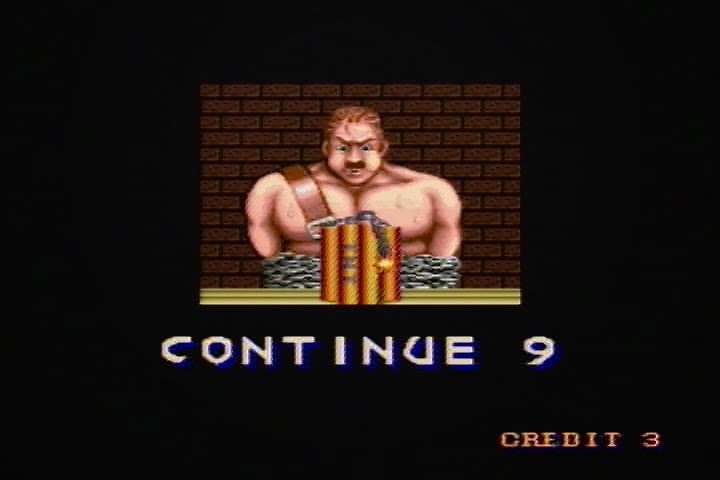
Now a big difference between the arcade or SNES port is the fact that your Continues on the arcade version are practically limitless (I mean the game was meant to last as long as the quarters in your pocket), while on the SNES version you have 6 lives per round and only 3 Continues. Once all of those are expended, you get a legitimate Game Over. As well, in the SNES version, if you go to the Continue screen (which by the way is one of my favorite Continue screens ever)...


...then you have to start the entire level over again. Yup, in the Arcade version you get to pick up where you left off, but here you have to start some very long levels over again. This even includes the unfairly long last level, which is littered with the toughest enemy types.

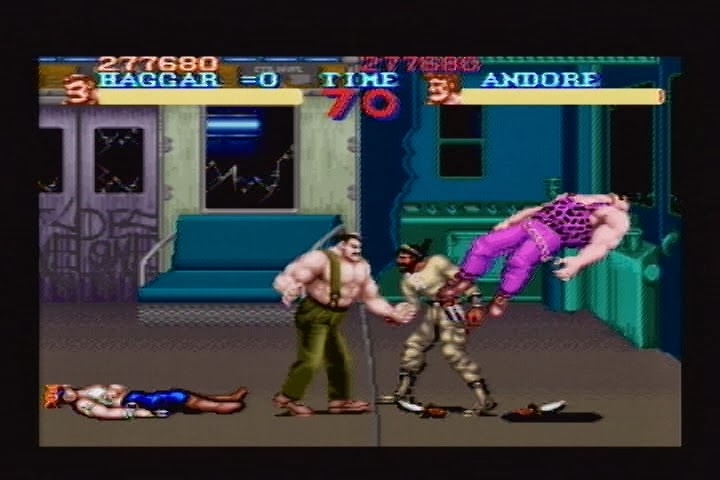
This wouldn't be too much of a problem if your characters didn't die so darn easily. A jab from an enemy will take off about a tenth to an eighth of your lifebar, while any solid hit can take up to a third to half of your life. Many attacks from larger enemies will just kill you outright. Probably the toughest enemy in the game is the "Andore" enemy, who is supposed to be based off of Andre the Giant.

These big boys have an instant kill move in that they choke you out, a mean dash attack, and they will try to body slam you if you get knocked on the ground. They also usually come in pairs too, and if you get sandwiched in by these guys, it will usually cost a couple of lives in order to fight your way out.

 I usually prefer to use Haggar, not only because he is the most awesome of the available characters (I mean he is the mayor of the freaking city and he is a literal hulk), but also because he is the most durable out of any of the characters. While Cody is certainly the faster of the two, Haggar has the ability to just tear through enemies while also being able to soak up a bit more damage.

Luckily the SNES version comes with a "secret" options menu (like a lot of older SNES games, the options are available if you hold L or R and then press start), where you can adjust the difficulty, the amount of lives you start with, and how many points you need to regain a life. This certainly makes the game a bit more manageable.

Pro Gamer Tips from the Pro Gamer himself

Some strategies I recommend for this game, as it can be pretty tough.

a) take you time to defeat every enemy in front of you. This seems rather simple, but really if you are getting penned in, the best thing you can do is stand your ground and start spamming the attack button. Enemies have a habit of walking into your attacks, and rarely ever block, and if you are moving around a lot, there is a slight delay between stopping your movement and beginning your attacks, thus it is better almost to stand your ground.

b) Learn the fighting controls. The controls are simple, but there are definitely some nuances. Grappling is one of your most valuable skills, as it can take out multiple enemies, and you can enable it when pressing the move button away from the way you are facing after finishing a combo. As well, the most useful move in the game is your "spin move," as it will negate any enemy attacks around you, including their combos. There are a lot of times where enemies will just continually knock on you, emptying your lifebar, and the spin move is the only way to break free from those attacks.

c) The bosses are rather tough. The first two bosses, Thrasher and Sodom/Katana, are a bit easier. They actually have patterns, can be easily stunned, and don't hit for an overwhelming amount of life.

Every boss after that though, is unfairly tough. The third boss, a big burly cop, can kill you with one hit of his baton and, when weakened, begins to shoot at you with his pistol, also an instant kill.

The fourth boss, Abigail, this strange punk-clown who is a sprite rip of the Andore enemies, is by far the toughest boss in the game. He has this grapple move that he spams constantly, where he grabs your character and then just tosses him like a beach ball, that is an instant kill. He can also withstand most of your normal attacks, which means that he can just attack through most of them. This boss just takes a lot of luck.


The final boss isn't too difficult, but he just hops around a lot and is tough to hit.

 I mean, he couldn't stop you from dropping him out a window.

There is one strategy that evens the odds with all the bosses, but it is a little cheap. This is buying the Turbo Controller for the  SNES, which allows you to spam the attack button at lightning speed. Use this on a boss to attack ceaselessly, and before your combo would technically be complete turn quickly left and then back to your opponent. This makes it so that you technically never knock your opponent out of your combo, and you can just wail on your opponent without interruption until they drop. This is how most Let's Players get through this game on Hard difficulty with no deaths.

Ads, Art and Commercial
Capcom is known for putting a lot of money into marketing, so here are some of the quality ads that came out for Final Fight. As well, I included some of the concept art, which is really impressive for this game.


The commercial is again a Japanese tv spot. They didn't seem to have one for the NA region. The Japanese commercial is...weird. I mean why is the kid in that elevator at night?


Final Verdict
Overall I have to say that I really enjoyed this game. It definitely has some flaws, but it is just so damn enjoyable overall. It has so much personality and inherent charm that it is tough to ignore. It reminds me of those old 80's action movies that are so bad that they are good, from the colorful punk enemies, to the giant Jesse Venture like protagonist, and the Commando like story. It is an awesome buy and a definite must have for anyone rounding out their SNES collection. You can usually pick it up for about $10 online.


Saturday, February 15, 2020

Super FamiComplete #5: Populous (Redux)

 
Title: Populous

Release Date: 12/16/90 (JP) 8/13/91 (US)

Developer: Bullfrog

Publisher: Electronic Arts (JP), Acclaim (US), Imagineer (EU)

When I first played this game, I was really frustrated. I found this game inscrutable and inaccessible, citing that this game did not effectively make the jump from a computer sim game to the console. Having played it again for this update...well, you'll see.

First things first; that Super Famicom box art is so much better than the North American box. It actually captures the mood and play style of the game, and sells a visual aesthetic. It is very rare, though, that the Japanese box is not better than the North American one (they have sold art books of Super Famicom box art).

Background
Populous is both an interesting game, and an incredibly frustrating one. It is an interesting game in that it is the first true God simulation game ever made (I really don't count Actraiser since it was more of a platforming/hack-n-slash hybrid), and it is one of the first games developed by the king of God-simulators, Peter Molyneux. You may know him as the brain behind other god-sim or hero-sim games, such as Godus, Fable, and Black and White. He also is pretty notorious for overselling the features in his games.
Odds are he just made a promise he couldn't keep.
The game, when it came out originally for the PC and PC consoles, was very well received and received universal critical acclaim. The game, after this, was soon ported to every available system and console under the sun, hoping to cash in on that PC success. Yet, as many developers learned during this period, just because something sells well on PC doesn't mean it can perform well on consoles. I believe that the SNES might have been one of the poorer ports of this game (I really can't comment on any of the others as I haven't played any of the others except the MS-DOS version).

This is a frustrating game, though, in that the interface, isometric controls, learning curve, and general game-play are all so murky and confusing that this game tests your patience. But more on that in a few seconds.

Gameplay
The goal of the game is simple: you, as a God, shape the Earth for your followers to grow and prosper so that they can take over the followers of your rival god, the computer. The player controls a whole number of miracles, such as raising and lowering the earth, creating floods, earthquakes, or raising volcanoes, each with a specific goal of shaping the earth in a way that benefits your own people or causing detriment to your enemy.

Case in point: here is the basic game-play interface...


One, you notice that there is a lot going on the screen. You have the overall map in the upper left, the meters of energy on the upper right, your game-play map in the center, and then two menus on the lower left and right that are always present. Now an interface like this would make sense on a computer, as you could quick scroll through commands with a keyboard, or even just click on a command with a mouse. On a SNES controller, though, this sort of system is VERY hard to navigate.

When you first pop the game in and start playing a match, you will most likely be confused. All you will likely see is a patch of green surrounded by all your cursors. Now all the menus are labeled with symbols, but they never highlight what these symbols do except through trial and error. Some of these symbols, such as the increase/decrease elevation, don't work if you don't have power. Now if you can't understand that you need power to perform these "miracles," as the game doesn't explain this to you, you will be pressing every button known to man until something happens. Eventually I made progress when I found a little guy, and noticed that if I managed to flatten out the land, he would build a little house. All of this I had to figure out on my own.

Even when I tried playing on the game's tutorial mode, no real help is given to you to help decipher the game-play; the tutorial mode is simply a blank slate map for you to play around with. The D-Pad helps you navigate around the map and the menus, and the select button switches you from the map to the menus. The A and B buttons, on their own, can raise and lower the Earth selected as you see fit. This is a complex game to not have any instructions included in the game-play. I imagine that, if I had the manual, some of these features would be explained, but, alas, I did not. I had to look up an online FAQ to figure out how to dig into this game. Now, imagine this was the early 90s before the internet became a mainstream thing, and way before online FAQs became a thing, what would I do as a gamer? Nothing! I would be pissed because I bought a new game that basically functions as an obtuse screensaver.

Weeeeeeeeeeeeeeeeeeeeeee.....

So okay, imagine you do your research and have the basic controls figured out. Here's the gameplay loop: each map starts with generally a couple humans available to you, with a couple others popping up from the enemy. The initial goal is to raise or lower the land around your humans in order to flatten it out so that it an be cultivated and settled (it's like Actraiser, but slow!). From there, the humans, generally on their own, will begin to build larger and larger homesteads and begin to populate. This will, in turn, grow your "mana" or belief power to higher heights, allowing you to perform new miracles. Eventually, your towns will grow and you can begin to raise military troops, and then target the enemy. This is very much an adversarial game. To succeed, you must conquer your enemy territory with your own. This means that it is really more of a sim/strategy game than just a fun "sim" game.

Now the menus around the map control such things such as if you can pause the action (the Zzzz icon),  waiting a "turn" within the game, changing day into night, etc. You can select your individuals (known as "peeps"...seriously), your townships in general, and use the menu to quickly shift between towns and areas on the map. There is a lot of depth for such an early SNES game.

  All these screens look the same...

I praise this game for not only its depth, but also its customization options. Before each match, you get to see all the options that are being set for this particular scenario, such as if your enemy "god" can use certain miracles, how aggressive they will be, etc (in Conquest mode, you do not get as much of a choice). For those who are interested, there are tons that you can do to modify your playing experience. 

This all sounds great on paper, but navigating this confusing jumble of menus, confusing controls, and maps is a huge mess when learning this game. As I said, the game gives no inherent indication of what to do, be it as far as controls or even what your objectives are. I didn't even realize, at first, that you had enemy troops; I just assumed everyone was my little believer until they started fighting one another (awkward). Also, the maps (unless you hold down a shoulder button), take a while to navigate, and once you have gotten away from a familiar area, it can be hard to find your way back to where you were. The massive amounts of menus onscreen are incredibly confusing; I still, after playing a good bit for this review, and then revisiting it for this review, AND after reading an FAQ online, still have no clue what some of the menu buttons do.

It doesn't help that the game is incredibly unforgiving. I played several "Conquest" matches against the computer, and usually by the time I could flatten my people's land, let them build their homesteads, and even think about raising an army, the enemy was already moving into my territory in droves. It is like a person going onto Battle.net and playing classic Starcraft nowadays; you will get dominated before you even have your feet under you.

If you are interested in this game, the most beneficial thing you can do, in game, is watch a match between two computer players, as that will show you how the game is "supposed" to be played.

Commercials and Ads


Final Thoughts
I just think that this game was way too much for the Super Nintendo, at least at this early in the SNES lifespan. This was practically a launch game for the system, and it is huge, and you can tell, even by the interface, that they are trying to jam it all in. And believe me when I say, this game will take FOREVER to complete (there are over 500 different levels and scenarios in the game to play through). It just seemed like the developers were grappling with the best way to put this game onto a fledgling system, and instead what they created was a lackluster port. It is just a struggle just to be able to tell what is going on within the game, so why would that be an enjoyable experience for me as a gamer?

In fairness, I will also say that this is not my type of game. I really struggle with sim games and building games. I am sure there are people out there who will dig this game, and will enjoy figuring out the inner workings and complexities. That person, though, will not be me. I don't enjoy this game one bit.

I have heard there are several good sequels for this game, so hopefully the later ones will remedy many of the problems.

I should mention that I do kind of enjoy the music to this game, even if it is a little repetitive. It is very atmospheric with this heart-beat motif. The heart-beat tends to quicken or slow down depending on how you are doing. Just a neat little side thought.

If you are interested in adding it to your collection, it is very cheap (around $5).

Well guys, that is it for this game. Next time we will be playing something a lot more...mindless to say the least. It should be fun at least.

#127: Pachinko Wars

  Title: Pachinko Wars Release Date: 7/17/1992 Developer: OeRSTED Publisher: Coconuts Japan It is finally time for the ever popular gambling...