Wednesday, February 12, 2020

Super FamiComplete #2: Super Mario World (Redux)


Game Title: Super Mario World
Release Date: 11/21/90 (JP), 8/13/91 (USA)
Developed by: Nintendo EAD
Published by: Nintendo

My blog post for Super Mario World was the first blog post that I was really intimidated by, which was unfortunate because it was my second post. Everyone and their mother has a copy of this game somewhere, as it is one of the best selling games of all time (I rank it up there as the Robert Kincaid of SNES games). All gamers have the warm and fuzzies for this game, and rightly so. It is the game that made that made the Super Famicom/SNES the juggernaut it was, and easily one of the most iconic "Mario" games. This game sold more copies than the first two Sonic games combined, and this game sold more copies than any other Mario game before it, save the first. As much as Sega commercials and purists would argue that this game was "more of the same" and much more "methodical" than Sonic, there is no denying its staying power. It is easily one of the most ported SNES games, and remains very playable to this day. So in revisiting this game, I know I will not have terribly much unique to say about it. I know this blog has always been more focused on hidden gems on the system, but I don't want to use that as a cop-out. Instead, my intent for this revamp is to seek out and find as much neat minutia that I can compile about this game, so that way at least each reader will be surprised by something.

My history with this game
Oh my goodness, I have a relationship with this game that goes back to my days as a toddler. It was one of the first video games that I loved to watch my brother play, and started to play myself. I think I have played through this game at least twice a year from ages 5 to 31. I have done quick playthroughs, completionist playthroughs, all Fort runs, you name it. This is a game that I have enjoyed with friends, I have enjoyed on road trips with the GBA ports, and I usually play when I just need to shut off my mind and go on autopilot.

Some fun memories...

1) I remember my brother putting this cartridge into the NES to see what would happen. Granted this is my four years old fuzzy memory, but I swear that the game played. Only half the screen would render without colors, and eventually the game crashed.
2) I remember when my brother was still living at home (I was 19 and he was 24 but about to get married and move in with his fiance), my best friend Joe came over. My friend Joe is a storyteller, and we spent the entire night listening to Joe talk about his crazy family and we would switch off every time he died. The only issue is that Joe is insanely good as SNES games, and he beat both Donkey Kong Country and Super Mario World without dying, all while telling stories. That was a good night.
3) I remember working at a country club, and one of the other employees realized that I collected games. After we worked a wedding and were released from work at 2 in the morning, I ran to my apartment to grab a SNES with Street Fighter II and Super Mario World, and we played both games in the lounge of the country club and drank the company's beer.

Background

This game was once again developed by Nintendo EAD, this time Team 1: Miyamoto, once again, limited his role to that of a producer for this title (though he still had a heavy hand in this production), and let Takashi Tezuka take over as the director (Tezuka would go on to direct other big projects such as Link to the Past; he is often called the "other" Miyamoto). The game took around three years to make (and even Miyamoto says he wanted more time on this project) with a team of sixteen people, which was a fairly large team for back then, especially over such a long period of time (many games were made in 6-8 months back then).

Miyamoto really wanted this game to feel "new" and different than what had come before it, and was unhappy with early builds of this game, as they felt too similar to SMB3. This game was also important for Nintendo's ongoing hegemony over the gaming space, as it was the first Mario game released in competition to the Sega Genesis, who was already about to debut Sonic the following year in North America.
Story and Setting
Unlike Mario Bros 3 which featured a set of worlds with stages within, Super Mario World features one large overworld map of an island called "Dinosaur Land." The basic story is that Princess Peach, while on vacation in Dinosaur Land, gets kidnapped by Bowser (of course), who had already taken over the island and established his Koopalings in castles dotted across the landscape (the Koopalings were originally Bowser's children, but Nintendo has since retconned this and made them just random underlings). Bowser had also captured and imprisoned the inhabitants of the island, the Yoshis; Bowser then used his sorcery to encapsulate them inside eggs. Yeah, remember when Bowser was also a dark warlock? Strange right? They kind of show that again in Super Mario Galaxy when he can disappear into dark portals, but they rarely show Bowser using his eldritch powers anymore.

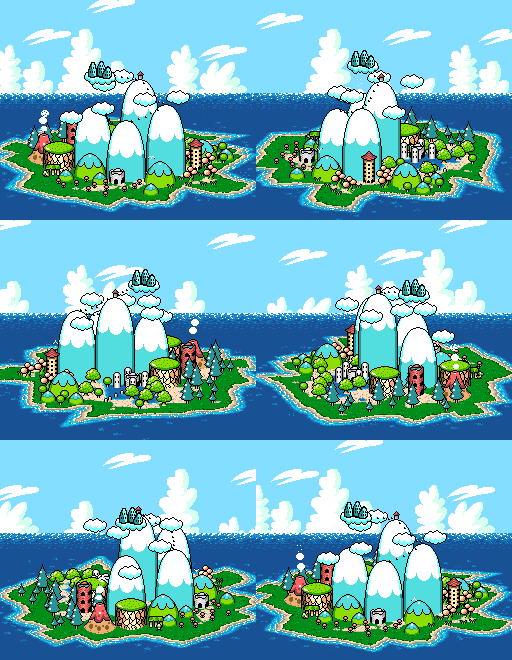
Now this continent is split into 7 regions (8 if you include Star Road, the super secret area): Yoshi's Island, Donut Plains, Vanilla Caverns, Cheese Bridge, Forest of Illusion, Chocolate Hills, and the Valley of Bowser. One thing I love about each area is that it doesn't follow a theme, but it instead really works to make this area feel like a real place. When you enter a part of the continent on the overworld map, that area on the map is represented by the stage you are in. Let me show you in an example.

This is the map of the first world, Yoshi's Island. You start at that cute little cottage in the middle. You can actually enter that cottage and see it bereft of its owners, the Yoshis, along with a note saying that they have been kidnapped. Already that sets a setting rather than a stage. If you follow the left path, you notice a stage in a flat area with hills in the background. Well this is what the stage looks like...


If you then go right, into the woods on the map, you then have the second stage, which actually takes place in those woods.


If you go up to the lake, you then have not just an underwater level, but a mixture of water in the setting they have already set.


This is something rather unique for the Mario series, even after this point. If you look at the New Super Mario Bros. games, they tend to set a theme rather than a setting. For example, they will do a "desert" world, and then just make desert themed levels regardless of where the stages fall on their map. Even their Wii U entry of this series, which purposefully hearkens back to the world map style of Super Mario World, doesn't really deliver on this promise. They just cordon their map off into themed segments, again, and just make a bunch of levels around that theme.

The world itself is really rich. The feeling of making your way across this continent is really felt, and it makes you, as a player, want to fully explore the various environments that you are placed in. This hearkens back to the time honored Mario tradition of hunting for secrets. Each area has plenty of secret levels, Switch palaces (which have switches which can unlock colored exclamation blocks in the rest of the world), and even alternate pathways for you to explore (you can actually make it to the final castle with just beating the first world and a few more levels if you know the secret paths). This is a rich world, which is why to complete this game, you can't just beat every level, but you must also find every exit for each level. (There are 96 exits in total). A level with multiple exits will be demarcated by being red on the overworld map rather than yellow. Some of these exits are really obscure; the one that sticks out in my mind is Cheese Bridge 1, which has an exit goal post behind the first one, and you have to purposefully either sacrifice Yoshi at the end or fly between the platform and the bottom of the screen.

The design of the world is really fun too. The Forest of Illusions forces you to find secrets in order to exit the world (or else Mario just travels in circles on the map), all while the creepy trees of the forest grin at you. In the Valley of Bowser you can see the silhouette of Bowser flying in his clown car above his castle, and as lightning flashes he raises his arms to intimidate you (also the neon "Bowser" sign on his castle? Awesome). I really love, too, how the first area, Yoshi's Island, seems like the game world at first, and then, after beating the first boss, opens up to the world map as a whole. It gives you that feeling like, "oh wow this game is going to be huge."

Gameplay
Now I really hope this doesn't take too much explaining, because Mario hasn't changed too much over the years. Now this is a traditional Mario platformer, in that the goal of each level is to get Mario from one side of the stage to the goal on the other side (be it a goal post or a boss fight). The challenge lies in how Mario must navigate the stage, either through platforming challenges or the enemies/obstacles that he encounters. Mario can also use power-ups, such as his traditional power-ups like the mushroom or fire flower, but also some new power-ups such as the P-Balloon and, most famously, the Wing Cape. The Wing Cape is great in that it allows Mario to effectively fly, adding a great deal of verticality to the stages. Unlike the Raccoon Leaf or Tanuki Suit, Mario is able (if the player is skilled) to keep his flight going unceasingly until he meets an obstacle.

This feels like the first Mario game which truly tries to diversify up its platforming challenges. In one stage, for example, it is a forest littered with bubbles. Sometimes these bubbles carry power-ups, other times they carry enemies, and these bubbles pop at random intervals. Another stage is based completely on platforms that move on a track, but there are also chainsaw blades that move along the tracks as well, so the player must hop between them. We see a lot of what would be that "Nintendo" design where an idea is introduced to the player in a safe setting, and then the challenge with that idea is slowly ramped up. For example, in the first cave level of Donut plains, the challenge lies in the yellow platforms that rise up and fall down on a global timer. They start off easy, with little chance to hurt Mario, and may even help him with his jumps; as the level goes on though, these platforms become a hindrance and death trap as Mario is in danger when they slam into the ceiling. The level then throws in Swoops, Spikeys, and Beetles to make things more tricky. Now I will say that there are some levels where it feels a bit more unrestrained in how the ideas are presented (the Dino Rhino stage is really tricky and chaotic, and has this weird secret exit tied to you moving through the stage at a good clip), but over all, the stages in this game are excellent, and seem to be progenitors for Mario stages in the future.

The layouts of stages are also very diverse: some are left to right, some are vertical, and some are complete mazes. In recent Mario platformers, left to right seems to be the common theme, and the more complex level layouts/emphasis on exploring was gifted instead to the Yoshi franchise.

Graphics and Presentation
Graphically, this game is beautiful: unlike the original Mario games, which inherently had a blocky look due to the 8-Bit graphics, the edges in this game are much softer. As one author puts it, the blocks in this game look like "well worn children's blocks." Everything is colorful and inviting. Most objects in the world literally smile at you, and even the angry faced Goombas now look like pleasant little waddling apples (the Koopas now wear little wife beaters and boxer shorts when knocked out of their shells; adorable!).

The detail put into this game is quite astounding as well, and the game used some really neat visual tricks to highlight the technical capabilities of the SNES. Some stages, like the Ghost Houses, have masks and overlays to their levels (these levels, as well, also push the amount of sprites onscreen to very high levels for this time).


And what about the main man himself? Well Mario is definitely a lot more detailed. He is a bit taller than previous games, and his sprite is fully detailed regardless of whether he is "small" or "big" Mario. You can actually differentiate the various parts of his outfit, from his overalls to his mustache to the whites of his eyes. They even added in some nice little touches and details, such as when he falls from a large height, his hat lifts slightly off the top of his head. My only issue with his design is that it is a bit rectangular. I imagine this was to keep a clear hit-box for his character, so that no players could claim that it was the game's fault that they lost a life. I understand it, and it isn't a big concern, but Mario just looks a little chonky as "big" Mario. They did update this in the GBA port by making his sprite a bit more proportional to what we would expect from a human, even a cartoon one.


This game also adds the now famous (and with their own series of games) Yoshi. It is now a well known piece of video game trivia that Shigeru Miyamoto, since first designing Mario, had always wanted to add a mechanic of Mario riding a dinosaur. This was impossible in these early NES Mario games due to the technical limitations of the NES. It was impossible to incorporate Yoshi and keep the smoothness and style of play that they wanted for the original Mario  and Mario 3. So finally, Miyamoto got his wish, and Yoshi certainly does shake up the gameplay quite a bit. Yoshi has to be "found" in an egg to be used, and then he can be ridden. He really serves as more of a power-up than a character. When ridden, he is a tad bit faster than Mario, and doesn't have as much of a slip-slidey quality as Mario does when he gains momentum. He also can eat many small enemies with his  incredibly dexterous tongue. Perhaps his most infamous feature is that he can even give Mario an extra boost (or a chance to escape death) by letting Mario launch off of his back. This means you can jump over a large gorge and then drop Yoshi into the pit in order to clear the landing yourself. A little macabre. Some other details I love about Yoshi is how the music changes whenever you ride on Yoshi's back. No matter what, the soundtrack of the stage will add a percussion element (bongos) when you are riding on Yoshi (I especially love that they kept this in Super Mario Maker and even added this to a whole bunch of sound tracks). Another strange detail is the fact that to get Yoshi to extend his tongue, Mario punches Yoshi in the back of the head (?!?). I tried to rationalize this, but Mario is clearly striking Yoshi, and Yoshi is giving a pained look as he extends his tongue.

Enemy Design
Super Mario World is definitely well thought out in terms of the nemeses that Mario faces, as they reflect this new locale of "Dinosaur" land. They are, for the most part, familiar but slightly altered to match this new environ. For example, instead of Goombas, you have Galoombas; now they are not able to be killed by jumping on them, but they can be stunned and picked up. Koopa Troopas are still present, but now they also can be kicked out of their shells (and they wear cute little wife beaters and boxer shorts), and depending on the color of their shells they act differently (blue ones will kick their shell at you, yellow ones will turn into "star" Koopas when they enter their shell). You have bullet bills again, but you also have the Banzai Bill, which is HUGE (they put him in the first level as a statement piece when he suddenly blasts in from out of no-where). Then there are just the strange residents of Dinosaur Land: you have the Rex, which is a blue dinosaur foot soldier who, like Mario, starts tall but can be jumped on to decrease his size, the Blaargs, which are lava dragons, and the Dino-Rhinos, which also come in big and small varieties, and can breath fire.
 
My favorite villain is definitely the Chargin' Chucks, which were introduced in this game. They are Koopas who wear football outfits and perform a bunch of different "sports" maneuvers. Some will kick footballs at you, some will throw baseballs at you, some dig rocks (?!?), and others just try to tackle you. The sound they make when they run at you is a bit intimidating, and they are one of the few enemies that take three hits to kill.

Boss Fights
Unlike prior Mario games, the boss fights in this game have a lot of variety in their designs. The boss fights in previous games were all just different iterations of the same concept. In the original Super Mario Bros, you just had to make it to the other side of the bridge while "Bowser" jumped up and down and shot fireballs at you; it would get harder as the layout of the bridge changed and Bowser eventually started throwing hammers too. In Mario 3, the Koopalings (who make a reappearance as the bosses of this game too), were all just cage matches where you had to jump on their head three times and avoid them and the fire from their magic wands. In World, the bosses instead have to be dealt with in different ways. Larry and Iggy Koopa, for example, are each on a floating platform amidst the lava, and have to be struck until they careen off the side of the platform. Wendy and Lemmy play a weird shell game, where you have to guess which pipe they come out of, and then strike them instead of their decoys, all while avoiding floating fireballs. There are even mini-bosses at the forts that help add some variety (they are all these dinosaurs called Reznors, but they are a nice change of pace).

Even the big bad, Bowser, has an interesting fight. He attacks you in his Clown Car (the first game that this appeared in), and must have his own Mecha-Koopas kicked back at him.

What about them sweet jams?
The music is fun and fast paced, and perfectly fits the ambience of each stage. Most stages have that honky-tonk style piano that keeps the fun lighthearted and energetic, while the Ghost Houses have an eerie synthetic organ that fits the "haunted" motif. Underground levels focus on bass and percussion, and the castle themes are fittingly sinister. One thing I love is that almost every song in this game is a play on one central musical theme. Here are some of my favorites from the soundtrack.


Secrets
There is Star Road, which has a series of levels that each have secret exits, and the only way to progress in Star Road is to find these exits. When you finally reach the final level of Star Road, and find that secret exit, you then make it to the "special" world, which has the most intense platforming challenges in the game, and some of the wackiest mechanics. There is one level, infamously, built around the P-Balloon that is super short but probably the toughest level in the game. If you can conquer this challenge, the game map then changes to autumn colors, and every Koopa gets replaced with a creepy Mario abomination (the "shell" of the Koopa is just Mario's head...ugh). 


Also, the speedrunning community has found a ton of weird stuff hidden in the data for this game, such as a Pong clone where the ball is instead replaced by Mario's head. It is really crazy stuff. By the way, if you want to see some really neat stuff, please check out the speedrunning community for this game. They have discovered some really crazy glitches and exploits to break this game wide open. This game can be finished in a matter of minutes, and there are some really fun categories for runs (the "All Forts" run is a surprisingly fun category, and the 96 exits is always enjoyable). 

Ads and Marketing


The North American commercial is very straightforward (if 90s as hell).


The Japanese one is now my favorite thing in the world. It makes me so happy I am adding these commercial segments.


Other Random Stuff
If you are well versed in this game and would like to try something new, then I highly recommend looking into the ROM Hack scene for this game. My personal favorite is Brutal Mario, which is just a really difficult and weird version of SMW. The bosses are all ripped from other SNES games, and there are some novel gameplay levels (some which actually would hold up in the actual game). Best actual level: a level with bullet bills that home in on you. Weirdest level: the one where you have to continually feed a Boo so it doesn't eat you. Most bat-shit insane part: where all the Koopalings congeal into the final boss from Romancing Saga 2 and become an eldritch abonimation.

Other recommendations include the Kaizo games and their offshoots (borderline impossible Rom Hacks built around punishing the player at every turn), 100 Rooms of Enemies, and Mario's Amazing Adventure Revitalized.

Verdict
If you have never played this game, I highly recommend it. It is top five for me, hands down. It is probably the game I return to the most out of any game in my collection. It is just pure soul candy; it doesn't matter whats going on in life, this game just simplifies things. Even among Mario games, this is a standout. 


Monday, February 10, 2020

Super Famicomplete #1: F-Zero (Redux)


Title: F-Zero
Release Date: November 21st: 1990 (JP), August 23rd 1991 (North America)
Publisher: Nintendo
Developer: Nintendo EAD

You know, when I originally started this blog, I never expected the game that I would return to the most would be F-Zero. I have very little fond memories of this game as a kid (more on them later), but ever since blogging about it, I tend to pick up and play it whenever it is rereleased on the SNES Online or SNES Classic. I think it is because of the function of the game: it was the tech demo for the SNES, and to test the fidelity of these ports, there really is no better game to check than with the original.  Also, the music and the gameplay helps a good bit too.

My experience with this game

Like I said, I did not have much experience with this game initially. I certainly knew of it, but racing games were never really my favorite genre as a kid. I played this mainly over at my buddy Evan's house. He had the typical "basement lounge" that was really an unfinished basement filled with storage, but also happened to have a couch and a tv. After those experiences, the only connection I really had to this series is that my other buddy, Joe, would always main Captain Falcon in the original Smash Bros. 

What is this game?

F-Zero is a plain and simple futuristic racing game, and really, this is one of the first arcade style racing games for a home console. You see, before this, most console racing games had either a side view or aerial view to their cameras (think Ridge Racer or Excitebike) yet the Super Famicom was the first to give you a proper, behind the driver, third person point of view. The aforementioned Mode 7 helped bring this to fruition. What is happening in F-Zero is the player is moving the background with the controls, not the racecar (though they animate the racecar so that it looks like it is moving). The sprite for the hovercar is actually stationary, but the player can accelerate and turn the background plane right and left, giving the appearance that you are speeding across the ground. Here is what it looks like in F-Zero: take notice of how the background moves with tight turns.


Well what about arcade racers at the time? Well arcade racers like Outrun generally didn't allow the player to control the screen; instead you are moving your car sprite left and right as obstacles come towards you. You are keeping your character on the road, rather than, as in F-Zero, maneuvering the road itself. 


Background
The game was developed by Nintendo EAD (meaning Entertainment Analysis and Development), directed by Kazonobu Shimazu, and produced by the main man himself, Shigeru Miyamoto. At the time of development, Nintendo EAD was split into three teams for the Super Famicom: the F-Zero team, the Super Mario World team, and the Pilotwings team, with Miyamoto overlooking all three of them as the producer. As far as F-Zero was concerned, Miyamoto pretty much gave Shimazu a free reign to design as he pleased graphically and aesthetically, as long as the gameplay itself was functional, tight, and fun. Thus you can see the hints of truly inspired design, as the backgrounds/environments, cars, and characters have a very manga and almost Akira inspired look.


Gameplay Pt.1

The game is bare bones in its presentation. I mean, look at this, no intro video or nothing, just a title screen and a road. This is what greets you when you turn the game on.

As well you only have three choices on the start screen, and only two "gameplay" choices: Grand Prix, Practice, and Records. After you choose the main gameplay option, you have a choice of only four racers...well not the racers themselves, but their cars. When you pick a car, its "statistics" are displayed along with their overall pickup/rate of acceleration. So you pick your racer car, the circuit you want to race in (again, only three are available...noticing a pattern here) and the difficulty setting, and you are off! 

Story
The official story of this game is that in the future, now that humans and aliens coexist on earth and most of Earth's ills have been cured, bored Billionaires have begun to fund a new racing circuit, with plasma fueled hover cars, to race around the galaxy. The game follows the four main racers, Captain Falcon, the “star” of the game, an ex-intergalactic policeman but now intergalactic bounty hunter...


 Samurai Goroh, a self proclaimed samurai, ex-comrade but now rival to Captain Falcon...


Dr. Stewart, the son of a wealthy businessman but now philanthropist and billionaire playboy...


 and  Pico, the only non-human racer and one of the galaxy's deadliest assassins...


 Wow these all sound like great and interesting characters whose stories would be amazing to see unfold in a racing game. Nintendo really wanted to sell this story and grab the players’ attention, and they released an 8 pg. comic about Captain Falcon with the manual. It’s pretty darn neat. 


The only problem is that NONE OF THIS IS IN THE GAME. You don’t even get sprites of these racers getting into cars, pictures of the racers during the races (a la Star Fox), or anything at all...just cars. They don’t even say the names of the racers, just the names of the cars when you choose them. I mean, I know this is back in the day where a lot of the story is listed in the game’s manual, but this game just drops you in with nothing else.

Gameplay Pt. 2


The various “cars” you play have very little difference between them. The Blue Falcon, Captain Falcon’s car, has better handling and a quick pick up, but its top speed is the slowest out of any of the cars, while Pico’s car is the fastest but has the lowest pickup and the worst handling. But really, these differences are negligible as, for the most part, they play pretty much the same.  The game seems to give you very limited choices, and then make even those choices relatively meaningless.


All of this aside, the game itself is pretty damn fun, if a little short. You have high speed races down twisted paths against other fairly aggressive racers. The goal is, in a usual Grand Prix style, to place high enough in each race to win the overall circuit. The races have twelve to fifteen racers, and each race has five laps. After each lap, the “limit” of what place you must maintain is decreased, so you pretty much have to stay at the head of the pack. One thing I like about this game is that it is pretty damn tough! What makes F-Zero different from other racing games is that you can die. Yup, it is pretty darn easy to crash out in this game, as there are tons of things that can kill you. If you hit a wall, it hurts you. If it hit a mine, it hurts you. If you hit a magnet, you get sucked into a wall, and that hurts you. If you get hurt enough, you die! If you place under the limit on a race, you die! And if you fall out of the course, you DIE! Die enough, and you get a legit game over. Races become more of an endurance race than anything else, as the courses get very complex, with sharp right angles and tough jumps. The biggest hazards, actually, are the other racers! They tend to get in your way, sneak up behind you, and slam you into the edges of the racetracks. As the races progress, the guys end up getting up injured themselves, so they will explode and do extra damage if you collide with them. These guys will throw off your races more times than any. Failure can come immediately and out of the blue.


The game also shows some of that classic Nintendo level design, as once the formula is taught to the player, they start playing with the player expectations. They will start to put speed boosts right before sharp corners or jumps that will carry the player out of the track. That jump that took me out of the race in the previous clip was so intricately placed that it was very hard to miss. Some of the levels also carry their own specific hazards, such as Death Wind, where there is a constant wind that pushes the characters towards the edge of the track.


The music, as well, is excellent, and pairs goes together with the action packed gameplay wonderfully. I have placed several samples below. 


The music pairs wonderfully with the aesthetics, which definitely have that aforementioned manga feel to them. What I really like about the settings of each race is that they tell an unspoken story. My curiosity is always piqued when I see Mute City in the background, or the emptiness of Death Wind (not to mention the mushroom clouds and giant skulls), and it makes me what life is like in each of these places. Also, what is that giant ship that comes and refills your life? Weird right? They never name that thing. 


The game, though, is rather on the short side. There are only three circuits with five tracks apiece. Once you beat this, there are only the three difficulties to play through on the same tracks, and a fourth “Master” difficulty to play once you beat each circuit on Expert. If you manage to beat this difficulty mode...that’s it. There are some stand out levels and races, though, such as White Land II, which has one of the most difficult jumps in the game, as it comes at the end of a section that forces you to tread slowly (pictured below).

Honestly one of the courses to learn, but super satisfying when you get it.
The final level of the game, Fire Field, is a crazy hard but very satisfying final race. The ending, though, is a little skimpy, as all the game does is congratulate you on behalf of your racer...kind of lame.

Wait more of those sweet tasty jams?


Ads and Marketing


Here is the US TV spot for F-Zero. I must say that it is pretty darn priceless.


Final Thoughts


 In my opinion, this game really is more of a tech demo than a complete game. The game is sparse on really everything else but pure gameplay. Beginning to end, the game takes about only 45-60 minutes based on how skilled a player you are. But the historical value of the game and its significance as to what it represented for Nintendo can not be ignored. It is crazy fun gameplay, but that is it. So while I would say that F-Zero is a game that everyone should own for their SNES collection due to its importance, I wouldn’t say it is a top tier game. It’s definitely a fun way to pass thirty minutes if you are bored one afternoon.


As far as hunting for this game, in terms of difficulty and price, this game is relatively easy to find. Nintendo released a ton of copies of this game, and I picked mine up at a vintage game store for about 5 bucks. Definitely not one of the harder games to find.


Friday, February 7, 2020

Super FamiComplete #0: The Super Famicom/SNES

Alright kiddos, gather round. Before the actual post, here is the promised update. Here is the deal. As I mentioned in my update post, this blog has been a source of consternation for me really since it started. I love this blog, but I feel I never had an idea of what I wanted this blog to be. Is it a chronogaming blog? Is it a rehash of research and wikipedia posts? Is it a early 30 something trying to cope with grief and an inability to sleep? Right now, mostly the latter. One thing I no for certain is that I was not really ever happy with what I was putting out. I was daunted by the "classics" of gaming, fearing that I had nothing unique to say about some timeless titles. I was crippled by the, often, lack of an audience, which filled me with doubt. I had fun when I was discovering something new, or went onto a weird research tangent about some kernel of trivia (I mean, "Jumbo" Ozaki? Love that guy). I really liked when I didn't get stuck in a SNES rut and branched out to some Switch games, and "Capcom: A to Z" has been a blast.

So here is what I am proposing. I need to get my 16bit Chronicles house in order first, or I will never be happy with this blog. I am going to slowly update my old posts, and bring them up to what I consider something worth attaching my name on. This format is going to use what I have learned so far making this blog, and it is going to mix it all into a delightful blog gumbo (hopefully). First, the format is going to be freeform but it is going to be a format still. I am going to be more conversational in my tone, but still informative. My issues with my early blogs is that there was no real format. It was just my thoughts on a game on a page. My issues with my later posts is that the format was so rigid that it beat all the interesting points out of the blog (herego the feeling like a wikipedia post). There has to be a happy middle ground. I feel this blog is not only informing my audience about some hidden gems in the Super Famicom/SNES catalog, but also delving into the minutia and experiences of playing through these old games as a seasoned gaming enthusiast in 2020.

This hopefully will lead to some new series and collections. My blog itself has been updated as far as aesthetics, and my next goal is to organize each "series" into something easier to follow and access. So here is the official lineup for this blog for 2020. If I stick to this I will be amazed but it is a good plan...


  • 16bit Chronicles is now officially titled "Super FamiComplete." I am going to focus on editing and restructuring posts to fit a new format. This might be minor, in some cases, or could be a complete rewrite. This is my main priority. As I update old posts, the original post will be deleted.
  • Capcom A to Z will continue and hopefully make it out of A soon. Alien v Predator for the Arcade is next, but after that is another Ace Attorney game, which will take some time to digest.
  • A look at Mascot games. I don't have a clever name for it yet.
  • Konami Z to A will be starting soon as a counter to my Capcom series.
  • I am also going to start looking at old DOS and Flash games available on InternetArchive/Flash Project.
  • Most likely another Chronogaming blog of another system too, because I hate myself. 

 So without further ado, here is the first updated post of the newly minted Super FamiComplete: a look at the library of the SNES and Super Famicom in chronological order by release date...What is the Super Famicom/SNES you ask? WELL.

The Machine behind the Premise behind the Blog

The Super Famicom (an abbreviation for Family Computer), as it was known in Japan, was released in Japan on November 21st, 1990, and on August 21st, 1991 as the Super Nintendo or Super NES in North America. The system itself was designed by Masayuki Uemura, who designed the original Famicom/NES system. The design of this little machine is Spartan in its appearance, and it is very light for a console. These appearances, though, are quite deceiving: the amount of processing power for this time period was quite impressive. On a personal note, these things were built to last. I still have my original from launch SNES, and this thing is a powerful little brick. With age, these things do tend to yellow, but their chassis is really quite sturdy. These systems can survive being dropped off buildings, being kicked around, and can even function underwater (DON'T TEST IT). Pictured on the left, below, is the Japanese version of the console, the Super Famicom; on the right is the Super Nintendo, its North American counterpart. The Super Famicom bit more colorful, especially on the controller, but both machines have the same specifications when it comes to functionality. 


So why the split in the blog, you may ask? Why do you have to differentiate between Super Famicom games and Super Nintendo games? Well, imaginary reader, the Super Famicom's games were region locked to Japan. This means that not all games developed for Nintendo's system were shipped or distributed in the US. In total, there are about 1600-1700 games in the Super Famicom library; only about 800 of those made it to the shores of North America.

Now, the region lock itself was functionally simple. To prevent American gamers from getting their hands and playing with a Japanese console, Nintendo built the region lock into their system. Here is quick show and tell. Here is a comparison of the cartridges (the items the software of the games were stored on) for the Super Famicom (bottom cart) and the SNES (top cart).
Notice how the Super Famicom cart is whole? Well you can't put them into a Super Nintendo, because in the port where you load cartridges on the Super Nintendo, there are two plastic prongs which will block the cart from being inserted. Now if you look at the Super Nintendo cart, you notice that there are two grooves at the bottom. This allows the cartridge to bypass those two plastic prongs. Now, if you are mechanically savvy (or really a novice, because I did this and I am terrible), you can remove the prongs with a pair of pliers or clips. You remove these prongs, well guess what? You now have a system that can play both SNES and Super Famicom games. Woohoo!

What was gaming like in 1990?

 The console "wars" between the Sega and Nintendo were in full swing. The Genesis had already been released in Japan on October 28th, 1988, and on August 14th, 1989 in North America, and it had taken both countries by storm. Before, Nintendo had enjoyed a complete hegemony over the console market with its highly popular 8 bit system, the Famicom/NES. Now, Sega had entered the market in a big way. Sega's first console, the "Master System," was considered a less than par console, but the Genesis was a huge technological boost up: it had a dual 8/16 bit processor, which allowed for boosted graphics, better sound, and a larger array of colors (it is worth mentioning that NEC'S Turbografx 16 was released around this time as well, but by the time of the SNES being released in North America, it had, for all intents and purposes, been relegated to the background of popular discussion). The processor on the Genesis was, for the time, a beast, which is why games like Sonic, released in June of 1991 (months before the North American SNES launch) were a huge hit. The Genesis allowed for breakneck speed in its games, as it could generate assets, backgrounds, and textures very quickly, something that not even the SNES would not have the power to accomplish without some technological workarounds.

Sonic the Hedgehog became a cultural counterpoint to Mario. Mario suddenly became the mascot for "kids" games while Sonic nabbed the teen demographic with his slightly edgy appeal (On a side note, I know this may seem funny since Sonic, as a character AND franchise has turfed so hard that he is a parody of himself, fanboyism, and gaming culture, but trust me he was the bee's knees back then).

This meant there was monumental pressure on Nintendo to put out a quality and revolutionary console with the Super Famicom and SNES. Sega had a very well established catalog of games by the time of the Super Famicom's launch due to many 3rd party developers jumping from Nintendo over to Sega. Nintendo had garnered a good bit of ill will from developers due to its controlling and limiting standards. To publish a game with Nintendo, it had to a) be up to code with its family friendly image (no nudity or violence, or religious imagery), b) be of the quality to receive that Nintendo Seal of Quality, and c) Nintendo was allowed to control and dictate the number of games developed, as they also made the cartridges for all the games (it didn't matter how much money that a developer would throw at Nintendo, they got the say in the market that game would receive). Sega, on the other hand, was much more lax in their standards and the actual content of the games. They were looking to topple Nintendo, and were willing to try whatever Nintendo was not doing to get that result.

Well the Super Famicom did release to a pretty sizable audience. Its initial order of 300,000 units ran out almost immediately, and the launch day in Tokyo was so disruptive to the local traffic that the Japanese government asked Nintendo to save future launch days for the weekends. The critical reception, as well, was great: while the Super Famicom released with only two games, the technological capabilities of the system were quite amazing. The first of the two launch games, F-Zero, showcased the design capabilities of the new system and specifically, Mode 7 graphics.

What is MODE 7?
What is Mode 7?!? Wellllll the main gimmick of the SNES was that it had 8 different graphical settings from Mode 0 on up to Mode 7, specifically in regards to the background rendering effects of the SNES. Each Mode from 0-6 was a setting for the different number of layers the background could have, the relative size of each layer of the background, and the number of colors available on the palette for those layers. Mode 7 was something a little different. Mode 7 allowed for the background to be scaled and rotated, which allowed for a faux-3D effect to be created. Early SNES games, such as F-Zero and Pilotwings were specifically created as tech demos for this feature. Perhaps a better way to explain it would be through visuals. Here are some popular uses of Mode 7.
This boss is actually a background layer, hence why it really isn't animated.

Mode 7 allows for the background to scroll.


This was considered a pretty dramatic graphical achievement for the era of video games, and made the leap from 8 bit consoles to 16 bit much more dramatic. Suddenly games were much more colorful, dynamic, and "popping" visually. 

What's my history with the SNES?
Well the SNES was the first video game system that I got invested in when I was a kid. I started my journey with video games by watching my brother. He had an NES, and when I was a toddler, I would sit and watch my brother play video games, utterly enraptured. Suddenly, when I was four, this machine arrived from "Santa" on Christmas, with Super Mario World and Street Fighter II. It was with these two games that I started to play myself. I would still have my brother fight boss characters for me, because they were a-scary, but I slowly grew more and more confident as I grew older. 

This is my favorite console of all time, yet one it seems that I have less and less time for nowadays. I rarely play it in favor of my PS4 or my Switch, and with the SNES classic and SNES Online, there just feels like less reason to hook the old machine up. Perhaps that's the reason I do enjoy this blog. It forces me to play with my favorite toy, and enjoy the labors of artists from my childhood. It is like reading through old Calvin and Hobbes, or eating comfort food from my childhood. 

Anywho, I am excited to jump into this project again and revamp it further. Of course, next time we will look at F-Zero once more. 


Saturday, January 18, 2020

Jan 2020 Update:Life and this crazy thing I call a blog

Hey everyone (or hey two or three people). Just wanted to give an overlong and overdue update. I'm sorry that there has been another lapse in posts, and I finally want to address the continuous lapses.

Last year my wife (at the time fiance of three weeks) was diagnosed with what has turned out to be a terminal brain tumor. She has a malignant brain-stem glioma that has proved resistant to most every type of treatment that we have tried. In the beginning, there was a lot of hope. We had the best doctors at one of the best cancer research hospitals in the world, with specialists in neuro-oncology looking into her case. It was a rare case (usually her type of malignant brain tumor is either a pediatric or gerontologic cancer), but doctors were hopeful that, with treatment, she would be able to keep it to the level of a closely monitored chronic disease that might need further addressing in 5-10 years. She had a biopsy, underwent many rounds of chemotherapy (both oral and infusions), a whole heaping helping of radiation, and of course the obligatory check-ups, blood tests, clinic visits, and consultations that come with having cancer. My role was as the caretaker who couldn't fix her, but could make sure that she had the most comfortable and best life possible. I planned our wedding, planned a honeymoon, and a ton of other things to just lift her spirits throughout this process. Cancer is a rollercoaster ride; much of the time you are just living in a holding pattern between MRIs and check-ups, hoping that nothing has progressed or changed. It drains you of energy and life, on almost every level. You are physically wiped from helping your partner, and they are debilitated from their disease and treatment. You are emotionally wiped from the sheer sadness and constant confrontation with mortality, and trying to put on a happy face anyway and enjoy what life you have left. You are spiritually wiped because you just see the doors of your future continually closing as a couple: no kids, no growing old together; at best you fight for a happy now. You get tired of people too: every family member, friend, acquaintance, or general Joe-Schmoe comes out of the wood work when they find out that someone they know is potentially dying, and many expect you to fit them into your schedule so they can see you and "make their peace." Some people are awesome about this and are enjoyable company; many aren't, making it clear they are just there for their own emotional self-soothing and aching guilt for not reaching out sooner. Finally you are just drained because life doesn't stop just because your SO is sick: bills still need to be paid, jobs still need to be done, and if you have to make accommodations for any of this a shit-ton of paperwork needs to be done.

As mentioned before, none of the treatments worked. In November my wife was given a few months to live due to the tumor growing anew at a much faster rate and at a much greater ferocity. Her condition has deteriorated rapidly since Christmas, and she has needed a surgical intervention to alleviate symptoms. If she makes it to her birthday in February, it will be considered a "miracle" according to her oncologists. I am terrified, she is some version of terrified that I can't even comprehend. We both feel defeated; cheated out of a relationship and happy life together. We cry most days, sometimes have good days, and watch a ton of "Amazing Race" reruns.

I really wanted to work hard on this blog this year, because this provided a necessary escape. I love video games; I have since I was a little kid. I love the games themselves, the culture surrounding them, and their rich history. I want to be part of the conversation around them (even if this blog is just me talking to myself sometimes). I look forward, when this is all over, to just jumping into them again. Hopefully this will be a healthy dive: a much needed escape rather than an obsessive rabbit hole (let's be honest it will be both). It has just been so hard to dedicate time this year, and frankly, I haven't been too pleased with the content that I have put out. I have done a more cursory glance at some of the games rather than give them the time they deserve, and my editing skills have been sub-par. I don't know when I will have time for this blog again, but I know I will return to it someday.

Here are the things I promise will happen when I do return to this crazy thing I call a blog...

1) There is going to be a big reformatting of 16 bit Chronicles. I am not happy with the format, and I feel like, with many games, I am just providing a synopsis of what is on its wikipedia page (this may be the fault of some of the games just not having anything interesting to say about them, but I still hold myself to a Rumplestiltskin standard of turning shit into gold). I may make the blog more experiential or diary style, or might make it more of a "challenge" style. I don't know, and it is going to take a lot of thought and planning in the next month or so. I may even change this thing into a podcast, or at least have a supplemental podcast to go with it. I also might start picking future games at random, as that will help break up the monotony of five clunker games in a row.

2) I am not happy with the look of the blog itself, and the design of the aesthetics is really noisy, outdated, and cheap. I am going to try harder on this end to make this a more accessible, noticeable, and pleasant reading experience. I might have to break out the old wallet on this one.

3) As far as side projects, I really do want to continue Capcom A to Z. I am having a lot of fun with that one, and I am enjoying playing old arcade games during my free period at work. I would also want to start looking at other "Games in Order" by developer, auteur directors or production companies, or other consoles. These side projects might also include other types of media. I really would like to start a "games club" style podcast and/or youtube/twitch channel, but am currently trying to shanghai one of my friends into joining me (as much as I love talking to myself).

4) Finally, I am going to try to keep myself to a blogging schedule, with a goal of making two blog posts a week. One of these posts would be a dedicated 16 bit Chronicles post, and the other of a different project (thought this might both be 16 bit Chronicles depending on the length of the game).

Finally guys...Happy 2020. I wish my new decade started on a better note, but hopefully things will look up someday far off down the road. Spare a loose prayer or thought for my anonymous wife you don't know and wish us luck on this difficult journey ahead.

Tuesday, October 8, 2019

Capcom A to Z: Age of Booty


Title: Age of Booty


Platform: Microsoft Windows, Playstation 3, Xbox 360

Release Date: Staggered by platform between 2008 and 2009

Current Status: Defunct

Developer: Certain Affinity

Publisher: Capcom

I have hemmed and hawed about adding Age of Booty to this illustrious blog for a couple of reasons: 1) I have had an incredibly difficult time finding a platform to play it on (in fact I haven't found one), and 2) it is only published by Capcom and not developed by Capcom. This game's servers seem to be defunct and not running anymore, and since this is an online real-time strategy game, not having servers means there is no game to play. So, instead, this will be a small analysis of this curio that has been lost to gaming history. 

Background
This game was developed by a company called Certain Affinity. Now the interesting thing about this company is the fact that they don't seem to have many of their own games (the only other one listed is Crimson Alliance, another XBox Arcade game), but instead they are primarily a co-developer who helps pitch in on multiplayer for big titles. They have worked on the multiplayer components for games like Halo: Reach, several Call of Duty games, Left 4 Dead, and the 2016 Doom. 

Not too much to about Age of Booty's development that you couldn't get looking of the game's wikipedia page. It seems pretty straightforward.

Gameplay
This game plays like a video game version of a board game; I am getting some very serious Settlers of Catan vibes from this game. You control a solitary pirate ship, and the game's goal is to attack neighboring regions and plunder their towns. The goal is to sack the target number of towns in an allotted period of time; the first team to do so wins. Each pirate controls their own regions, and must balance defending their towns with attacking their neighbor's towns. A town is destroyed when it loses all its HP. Towns will also heal your ship when you are in a neighboring region. 
The game map is split into hexagons, that you move between. This seems to be implemented to help increase the speed of play and help streamline some features. For example, when you are in a hexagon adjacent to any enemy structure or ship, you automatically attack the enemy. When you are next to an allied town, you automatically heal. This keeps the game moving at a very good clip, and allows the player to focus on positioning rather than issuing commands. 
The game itself did boast a single player mode of 21 missions, which reportedly were very tough, but the main spotlight of the game seemed to be multiplayer. Reviews of the multiplayer alone were very favorable, with most reviews mentioning it as a fun, pirate-stylized pick-up-put-down fast-paced game. The game did get an iOS spinoff called Age of Booty Tactics, so it must have received some sort of following, but it was not published by Capcom, so for the sake of our blog, who cares. 
In the end...
Seems neat; shame there is no way to really play it nowadays. Till next time folks!

#127: Pachinko Wars

  Title: Pachinko Wars Release Date: 7/17/1992 Developer: OeRSTED Publisher: Coconuts Japan It is finally time for the ever popular gambling...